

Door must be closed for tobacco lobby in Brussels
Youth Smoking Prevention asks European Commission to consult WHO
29 October 2026
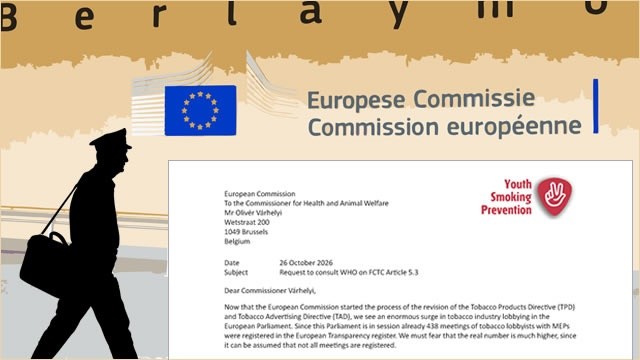
In a letter to European Commissioner Várhelyi, Youth Smoking Prevention suggests that the European Commission asks the WHO for advice on the application of FCTC Article 5.3. The question must be whether this anti-lobby article also applies to the European Parliament.
By the web editors
The European Commission must seek advice from the World Health Organization (WHO) on the application of Article 5.3 of the Framework Convention on Tobacco Control (WHO-FCTC). The question must be whether the article, which is intended to prevent the tobacco industry from influencing tobacco policy, is also valid for the European Parliament.
This is the suggestion made by Youth Smoking Prevention in a letter to European Commissioner Olivér Várhelyi (Health and Animal Welfare) that was sent this week. A request from the Commission to the FCTC Secretariat for further clarification on the validity of Article 5.3 for elected representatives may lead to the European Parliament (EP) having to close the door to tobacco lobbyists.
Four times as many lobbying contacts
Just this week, Smoke Free Partnership (SFP) in Brussels published an update on the enormous increase in the number of registered meetings between MEPs and tobacco lobbyists. In the last two years, since the current European Parliament has been in session, more than four times as many meetings have been registered in the European Transparency Register than in the entire previous parliamentary term.
Already 438 meetings
Between 2019 and 2024 about 100 encounters were recorded, according to Politico. Since July 2024, more than 430 meetings have already taken place in the current parliament. TabakNee already counted 438 in the overview of Lobby contacts up to October 1 of this year. It can be assumed that this is an underestimate, because not all encounters are registered.
Tobacco policy review is imminent
The enormous increase in lobbying efforts is no coincidence. The European Commission is now reviewing the entire European tobacco policy. In anticipation of this, the tobacco lobby is trying to influence the upcoming discussion of Commission proposals in the European Parliament (EP).
Many contacts about the excise duty directive
Recently, many meetings have been about the revision of the Tobacco Excise Directive, for which European Commissioner Wopke Hoekstra (Tax Affairs) submitted a proposal in July 2025. The European Parliament only has an advisory role on this subject, but a statement by the EP is nevertheless taken seriously in the Council of Ministers.
However, on 17 June, a compromise agreed in the ECON Committee was voted down in the plenary parliament. This made the impasse on this file even greater. Delaying decision-making is one of the well-known tactics of the tobacco lobby.
Proposal for new TPD is coming soon
A proposal from the European Commission on the revision of the Tobacco Products Directive (TPD) and the Tobacco Advertising Directive (TAD) is also expected before the end of this year. The tobacco lobby is trying to get European politicians to join forces for more lenient rules for alternative nicotine products such as e-cigarettes, heated tobacco and nicotine pouches, that are presented as less harmful than cigarettes.
Lobby stopped e-cigarette as medicine
The influence that the lobby can have on tobacco policy can be seen in the outcome of the previous revision of the TPD in 2014. At the time, the Commission and European ministers proposed to distribute e-cigarettes as a quitting aid only through pharmacies. Amendments from the heavily lobbied EP ensured that e-cigarettes remained on the market as a consumer product.
Interviews with 193 MEPs
SFP notes that the tobacco lobby has now spoken to 193 of the 720 MEPs. It is not only employees of tobacco companies who visit MEPs. SFP counted 40 different parties lobbying in the EP on behalf of the tobacco industry. TabakNee’s overview of lobby contacts shows that the lobby mainly tries to manipulate the Christian Democratic EPP (133 meetings). In this way, the lobby hopes to attract EPP members to the conservative and ultra-right camp.
Mainly German and Italian members
SFP also noted that mainly MEPs from Italy and Germany were visited, followed by Spain, the Czech Republic and Romania. The organisation calls on the European Parliament and all EU institutions to strictly comply with FCTC Article 5.3.
5.3 applies to ‘all branches of government’
In the letter to European Commissioner Várhelyi, Youth Smoking Prevention (RPJ) writes that the Guidelines on the implementation of Article 5.3 are clear about the scope of the article. This provision applies to “all branches of government”, including the “executive, legislative and judicial” institutions. According to Youth Smoking Prevention, the FCTC Secretariat will address this issue in more detail as soon as requested by one of the 180 parties to the Framework Convention.
Unique determination for unique industry
The letter concludes: “The tobacco industry is the only industry that markets highly addictive and at the same time harmful and life-threatening products. This unique industry is therefore regulated by a unique international UN convention that includes a unique article barring tobacco lobby from influencing policy making. Parliamentarians everywhere should not be excepted from this rule.”
Also read:
Tobacco lobby in the EU rumbles on
Tobacco lobby retains free access to the European Parliament
Tobacco lobby just at the table at the European Parliament
Three Nordic countries close door to tobacco industry
Code of Conduct French Parliament mentions Article 5.3 FCTC
The House of Representatives is indeed bound by the FCTC treaty







 Stichting Rookpreventie Jeugd is geregistreerd als Algemeen Nut Beogende Instelling (RSIN: 820635315 | KvK: 34333760).