

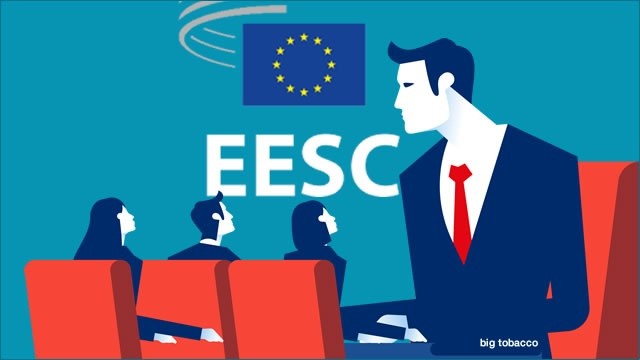
EU advisory body speaks language of tobacco lobby
Dossier: Lobby in Europa
12 March 2026
An opinion of the European Economic and Social Committee on the revision of the Tobacco Excise Directive lists all the arguments that the tobacco lobby also puts forward against the proposal. Attempts by an EESC member to bring the opinion more into balance all failed.
By the web editors
An opinion of the European Economic and Social Committee (EESC) to the European Commission (EC) of 18 February on the revision of the Tobacco Excise Directive (TED) reflects loud and clear the lobby of the tobacco industry. All the arguments that the lobby repeatedly puts forward against the EC’s revision proposal can be read in the advice.
The EESC is a European advisory body and the voice of organised civil society in Europe. The EESC brings together employers, workers and civil society organisations from all 27 EU Member States. The EESC states on its own website that “the expertise of its 329 members helps optimise the quality of EU policies and legislation”.
In the case of the advice on the revision of the TED, optimisation is only possible from the perspective of the tobacco industry. The opinion states, among other things, “that the reform must remain proportionate, predictable and economically sustainable” and “warns against abrupt or excessive increases in excise duties, which risk fuelling illicit trade, undermining fiscal revenues and weakening public health outcomes.” A third recommendation “calls for the consistent application of risk-proportionate taxation, ensuring that non-combustible and reduced-risk products are not taxed the same as combustible tobacco products”
Arguments of the tobacco lobby
These arguments are directly reflected in the opinions that the tobacco lobby tries to disseminate wherever it can. Recommendations to take into account the economic significance of the sector and the employment it offers is also an argument that the tobacco lobby has been sounding louder and louder lately, conveniently leaving the damage to the economy and society unmentioned.
The explanatory notes to the recommendations start with two remarkable starting points. Firstly, the EESC stresses “the principles of proportionality and fiscal neutrality, avoiding distortions and disproportionate economic impacts on European production chains.” And the second starting point reads that “While the EESC fully embraces the commitment to reducing tobacco consumption, it emphasises that taxation cannot be the only, nor the principal, tool to achieve this goal.”
That is certainly not what the World Health Organization (WHO) says about this. The WHO states that the 1.6 million deaths each year from tobacco use in the WHO region of Europe (53 countries in Europe and Central Asia) call for a strong excise policy. The organization writes on its website that while a combination of measures is always needed to combat the tobacco epidemic, “increases in tobacco taxes are known to reduce tobacco consumption faster than any other single measure. For this reason, taxation is a crucial tool in the effort to attain a tobacco-free Europe.”
Amendments criticized
The record of proceedings of the EESC’s plenary discussion on this opinion on 18 February shows that any attempt to provide the opinion with nuances and adjustments that would bring it more into line with health arguments did not stand a chance. Andris Gobiņš, President of the European Movement in Latvia and EESC member of the Civil Society Organisations Group, proposed some twenty amendments. All proposals meant to add comments to the text about discouraging tobacco or vape use or, on the contrary, to delete passages that are clearly in favour of the industry.
Gobiņš was apparently reproached for this, as the report mentions that EESC President Séamus Boland “and several members expressed solidarity with a member of the Committee who faced pressure for tabling amendments and emphasised that any EESC member must be able to fulfil their roles without threat to their integrity and independence.”
The report shows that Gobiņš withdrew all his amendments and then resubmitted them jointly with 33 other members of the Civil Society Organisations Group.
Two striking amendments
The most striking of these is Gobiņš’ Amendment 14, which was subsequently reintroduced as Amendment 37 submitted jointly. In doing so, Gobiņš tried to prevent the EESC opinion from advocating a lower minimum rate of excise duty compared to the EC’s proposal. Instead of a minimum rate of EUR 215 per 1,000 cigarettes, as the EC wants, the EESC recommends a minimum rate of EUR 155 per 1,000 cigarettes. Gobiņš tried to remove that lower rate from the advice, but that proposal was voted down by 187 votes to 43 and 18 abstentions.
In Amendment 15 (later Amendment 38), Gobiņš tried to prevent the text from linking increases in excise duties in France and the Netherlands to an increase in illegal trade. The Latvian tried to avoid that the advice would state that a total loss of 15.5 billion euros is to be expected with the “excessive excise increase” included in the EC proposal if it would cause a 5 percent growth in illegal trade. Gobiņš countered this with a text that states that Sweden and other member states have shown how to stop the use of the most harmful tobacco products and added the sentence: “Gains in health – cancer treatment, higher value of life etc. are significant and should be wider spread.” That proposal was defeated by 188 votes to 44 and 16 abstentions.
‘Swedish success’ added
Was Gobiņš trying to win over the members who are sensitive to the arguments of the tobacco industry by explicitly naming Sweden? The ‘Swedish success’ has long been a misleading narrative of the tobacco industry, which makes it seem as if so little smoking is done in Sweden because snus is allowed there and nicotine pouches are popular. The reality is that Sweden has been pursuing a coherent tobacco control policy since the 1960s.
All the more remarkable that an amendment that was initially tabled by the rapporteur of this opinion, Matteo Borsani, and later adopted by the entire Employers’ Group, adds exactly this Swedish success narrative to the text. Amendment 5 (later 30) adds the following passage to a text advocating a lower excise duty for less harmful products:
“For example, lower rates on nicotine pouches in Sweden have allowed – along with other measures – the smoking incidence to drop to 5.4%, the lowest in the EU. The Commission proposal of setting a minimum rate of €143 per kg is disproportionate compared to Sweden’s current rate and fails to reflect the reduced-risk nature of this category within the excise framework.”
Even more remarkable than that: this amendment was adopted unanimously by the assembly.
The lobby rejoices
The result of the deliberations is an opinion that fully follows the reasoning of the tobacco industry against the EC’s proposal for the revision of the Tobacco Excise Directive. Which is then seized upon by the lobby to further influence European decision-making. Not only was the advice widely reported by news site EU Reporter, which has often been shown to propagate the voice of the tobacco lobby. But the World Vapers’ Alliance, a front organization of the tobacco industry, also rejoiced that Europe’s own advisors now also backs the principle of ‘less damage, less tax’. And on LinkedIn, EU Reporter’s story was shared by Quit Like Sweden, also an industry front organization.
European politicians should be aware that an example such as this EESC opinion shows how much influence the tobacco lobby is exerting itself on many fronts at the same time, contrary to the provisions of Article 5.3 of the World Health Organisation’s Framework Convention on Tobacco Control. After all, that article says that decision-making on tobacco policy must be free from any influence by the tobacco industry. It appears that the tobacco lobby has ample access to the EESC for the time being.
Do you want to keep updated on all the news about the tobacco lobby in Europe? Sign up for TabakNee’s monthly newsletter.
tags: Tobacco Excise Directive | TED | EU | tobacco lobby






 Stichting Rookpreventie Jeugd is geregistreerd als Algemeen Nut Beogende Instelling (RSIN: 820635315 | KvK: 34333760).