
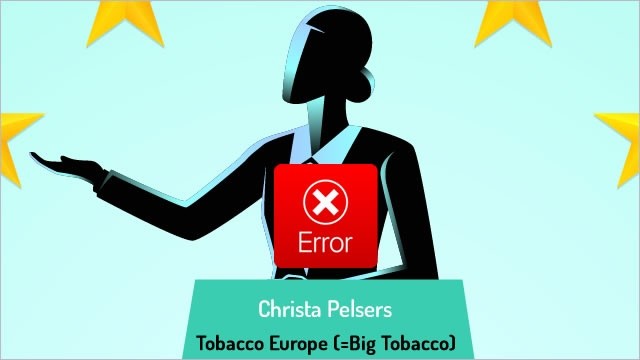
EP invites tobacco lobby to the table
Dossier: Lobby in Europa
04 December 2025
Without causing any commotion, a representative of the tobacco industry was able to openly try to undermine the proposals during a hearing of the European Parliament on the revision of the Tobacco Excise Directive. FCTC Article 5.3 is completely ignored by the EP.
By Bas van Lier
Without causing any fuss, the tobacco industry was given the opportunity to have its say in the European Parliament last month during a public consultation on the revision of the Tobacco Excise Directive (TED) at the Standing Committee on Fiscal Affairs (FISC). One of the invited ‘experts’ to the hearing was Christa Pelsers, Chair of the Fiscal Affairs & Anti-Illicit Trade Working Group at Tobacco Europe, a trade association representing British American Tobacco, Imperial Brands and Japan Tobacco International. Pelsers was given free rein to present the tobacco companies’ objections to the proposed increase in the minimum excise duty on tobacco and the introduction of excise duty on alternative nicotine products.
The fact that the tobacco industry is given the opportunity to have such an open say in the design of tobacco policy is bizarre. It is incomprehensible that there has been no fuss about it. It shows that the WHO Framework Convention on Tobacco Control (FCTC) has no value whatsoever for the European Parliament. In fact, the most important article in it, article 5.3 about shielding tobacco policy from the commercial and vested interests of the tobacco industry, was completely ignored here. The fact that the influence took place in public does not detract from this.
Only necessary contact
The text of Article 5.3 leaves little room for interpretation. It states that “in setting and implementing their public health policies with respect to tobacco control, Parties shall act to protect these policies from commercial and other vested interests of the tobacco industry in accordance with national law.”
The European Union is one of those Parties to the treaty, the Union signed it in 2004 and thus contributed to its entry into force in 2005. In 2013, the WHO published Guidelines for the implementation of Article 5.3, which further explain how parties should apply the anti-lobby article. It states, among other things, that “any government branch (executive, legislative and judiciary) responsible for setting and implementing tobacco control policies and for protecting those policies against tobacco industry interests should be accountable.”
The guideline also states that contact with the tobacco industry should be limited to those cases where it is strictly necessary to “effectively regulate the tobacco industry and tobacco products”. And such necessary interactions should then take place in public as much as possible.
The well-known counterarguments
There was no necessary contact to effectively regulate the tobacco industry and its products during the hearing. Instead, the representative of the tobacco industry was given the space to convince MEPs in the middle of the policy development process why the European Commission’s proposals are flawed. Pelsers did not put forward any technical arguments as to why the revision proposal would be practically impracticable. Instead, she raised the well-known objections from the industry: higher excise duties will generate less revenue for the Member States, illegal trade will flourish (with reference to KPMG research commissioned by the industry) and excise duties on alternative nicotine products do not consider their reduced harmfulness. This is nothing more than directly influencing a policy plan in development.
To what extent Professor of Economics at universities in Venice, Rome and London Francesco Moscone has been influenced by the commercial and vested interests of the tobacco industry cannot be determined, but he used largely the same arguments: higher excise duties will lead to illegal trade, inflation will increase, and nicotine products must be priced according to their degree of harmfulness.
MEPs influenced by lobbyists
Of whom it is crystal clear that he was manipulated by the tobacco industry is MEP Marco Falcone, who is part of the Christian Democrat group EPP on behalf of Forza Italia. According to EU Reporter, Falcone pointed out during the discussion that several studies show that heated tobacco and e-cigarettes have ‘a different impact on health’ that is not reflected in the proposal. Falcone had four meetings with representatives of the tobacco industry between 15 October and 11 November, as shown in our updated overview of lobbying contacts in the European Parliament. The non-aligned MP Fernand Kartheiser of the Alternativ Demokratesch Reformpartei from Luxembourg was also visited by the industry four times between September 25, 2024 and November 25 this year. Kartheiser argued that the European Commission exceeded its powers with its proposals.
Now that the discussion about the TED is reaching a climax, the tobacco lobby is constantly influencing the European Parliament. In October and November, we counted more than 40 new meetings, practically one per working day.
‘Swedish success’ is deception
During the hearing, there was a rebuttal to the lobby from the industry. Hana Ross, Senior Research Fellow at the Vienna Institute for International Economic Studies, also affiliated with the University of Cape Town, argued that the proposal has several shortcomings. There is no fixed adjustment of excise duty rates to inflation or income growth, newer tobacco or nicotine products are excluded from the directive, and there is an unjustified advantage for roll-your-own tobacco in the rates. This ensures that the affordability of tobacco and nicotine products does not decrease, that border effects are stimulated and that substitution between tobacco and nicotine products is incentivised rather than reducing their use.
Finally, Gijs van Wijk of Smoke Free Partnership called the commission proposal an “important step toward closing the price gaps that the tobacco industry has long exploited.” He mentioned the harmful effects of nicotine use in any form and undermined the tobacco lobby’s narrative about Sweden’s ‘smoke-free success story’. ‘Smoke-free’ products such as e-cigarettes and nicotine pouches would have led to a minimal number of smokers there.
The reality is different, Van Wijk argued: 29 percent of 17-year-olds in Sweden use nicotine pouches and the tobacco and nicotine use of 16- to 29-year-olds has risen from 30 to 35 percent in two years. “That’s not a smoke-free generation, that’s a new nicotine-dependent generation.” According to Van Wijk, the figures from Swedish health organizations show that nicotine pouches are not a quitting aid, but a stepping stone to nicotine use. In addition, the tobacco industry invariably fails to mention in the Swedish success story that the Swedish government has continuously taken measures to reduce tobacco consumption, including regular adjustments to excise duty rates.
“The tobacco industry has a long history of manipulating evidence, and it should not be allowed to shape EU public health policy ever again”, Van Wijk said. For the time being, however, the opposite seems to be the case.
If you want to keep updated on TabakNee's news in English, sign up to our monthly newsletter in English
tags: tobacco lobby | nicotine lobby | TED | FCTC | Tobacco Excise Directive | European Parliament | nicotine addiction






 Stichting Rookpreventie Jeugd is geregistreerd als Algemeen Nut Beogende Instelling (RSIN: 820635315 | KvK: 34333760).