
Tobacco endgame is also a communication issue
25 February 2026
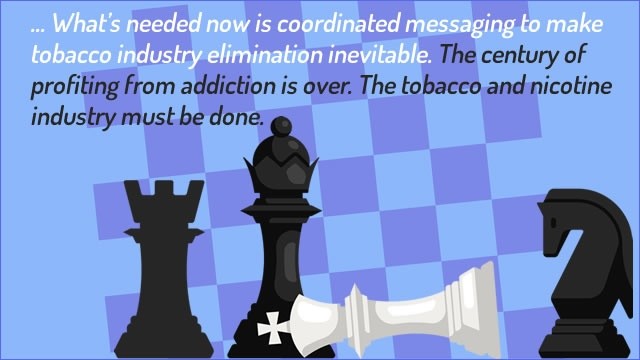
A new report from Action on Smoking and Health USA shows why the idea of ending the tobacco industry, the so-called Tobacco Endgame, is gaining little political traction, and how better communication can change that.
By the web editors
A new report by the American organization Action on Smoking and Health USA (ASH) states that the fight for the so-called ‘Tobacco Endgame’, the complete end of the tobacco industry, stumbles due to poor communication. Despite decades of tobacco control policies, the industry is adapting faster than regulators can keep up with, while its products kill at least 7 million people annually and generate $880 billion in sales – more than Google, Meta and Apple combined. Why does the idea of ending the industry get so little political traction? According to the report, the answer lies partly in the story that proponents tell.
Three fundamental weaknesses
The report Making Tobacco Industry Elimination Inevitable: Communications Strategies to Reach the Tobacco Endgame identifies three fundamental weaknesses in current communication around the tobacco endgame. Firstly, there is no unambiguous definition: one expert understands it to reduce smoking prevalence to below 5 percent, another to completely phase out the sale of tobacco products, yet another focuses on all nicotine products. Second, there is no cohesive narrative that makes the concept accessible to a wide audience. And thirdly, the concept remains largely unknown outside the circle of tobacco fighters.
The result is a vicious circle: what is unknown is not discussed, and what is not discussed cannot be normalized. Policymakers who do not know that elimination of the industry is a realistic option, opt for incremental policies that give the industry room to open up new nicotine markets.
Fourteen recommendations
The report makes fourteen concrete recommendations to improve communication around the endgame. The focus is on a clear definition. According to the report, the word ‘endgame’ contains two elements: an end; a concrete, measurable end to the activities of the tobacco industry with a specific date, and a game; strategic paths adapted to the local context. Together, the tobacco endgame thus becomes: a concrete plan to end all activities of the tobacco industry with a specific timeline and strategy per region.
Furthermore, the report emphasizes that the tobacco endgame is not a silver bullet, but a flexible toolkit of different policy measures that together systematically reduce the market for tobacco and nicotine. Think of reducing the number of points of sale, a licensing system for tobacco sellers, a generational ban such as Nicotinee proposed in the Netherlands, or the complete withdrawal of certain products from the market. Which combination is most effective differs per country and context, hence the ‘game’ element in the endgame.
Include all nicotine products
The report also warns against limiting the tobacco endgame to tobacco products only. The industry’s switch to e-cigarettes, heated tobacco and nicotine pouches is not a strategy to reduce the harm of cigarettes. Internal documents show that it is a deliberate plan to maintain profitability and regain social acceptance. Anyone who focuses the endgame only on tobacco is playing right into the hands of the industry.
Other recommendations: frame every policy proposal from how it dismantles the power of industry (not from the policy technique), use the term ‘realistic’ instead of ‘radical’, and always start by naming the already high public support for endgame policy.
From advertising agency to tobacco control
The report was written by Eline Goethals, a Belgian communication strategist who made an unusual career switch in 2024. Inspired by Rutger Bregman’s book Moral Ambition, she left the advertising world to focus on what Bregman calls ‘Big Problems’ – urgent global challenges where talent is needed. Through The School for Moral Ambition, founded by Bregman, she was placed as a fellow at the Institute for Global Tobacco Control at the Johns Hopkins Bloomberg School of Public Health.
Goethals’ background in advertising turned out to be surprisingly relevant. Earlier in her career, she worked at an advertising agency for a tobacco brand and saw up close how the industry uses creative agencies to circumvent regulations and reach young people. That experience made the switch to tobacco control personal. The report was co-authored with the support of Chris Bostic and Megan Manning of ASH USA, and with the guidance of dr. Joanna Cohen of Johns Hopkins Bloomberg School of Public Health.
Relevant for the Netherlands
Although the report is internationally oriented, it also contains data that are directly relevant to the Dutch situation. For example, research shows that 71 percent of Dutch young people think that the tobacco and vape industry should not exist. The increase in the age limit for the purchase of nicotine products to 21 years proposed by the new cabinet, an important step towards the elimination of tobacco use, is also supported by 73 percent of the population. Moreover, the Netherlands is leading the way with the planned reduction of tobacco retail points until 2032, also an important element within the tobacco endgame. The report offers tools for everyone who communicates publicly about tobacco policy – from researchers and policymakers to advocates and journalists.
The full report can be read on the ASH website.
tags: Nicotinee | nicotine addiction | School for Moral Ambition | Tobacco Endgame | ASH







 Stichting Rookpreventie Jeugd is geregistreerd als Algemeen Nut Beogende Instelling (RSIN: 820635315 | KvK: 34333760).