
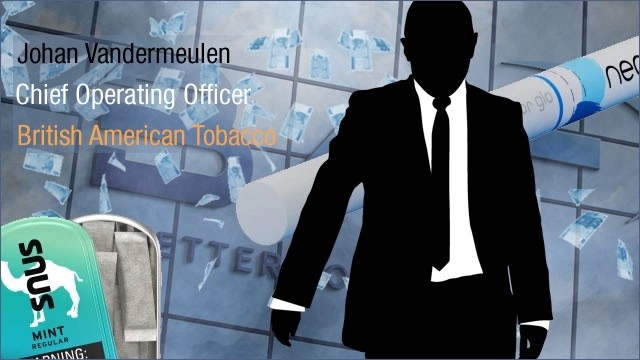
Johan Vandermeulen: executor of BAT’s ‘lost moments’ strategy
09 December 2025
In 33 years, Belgian Johan Vandermeulen rose from marketing trainee at BAT Belgium to Chief Operating Officer of the world’s second largest tobacco company. The Fleming is responsible for the global implementation of BAT’s strategy to offer alternatives to the ‘lost smoking moments’ due to smoking bans.
By the web editors
The name Johan Vandermeulen recently surfaced in an interview in The Korea Herald, in which the Chief Operating Officer of British American Tobacco (BAT) touted South Korea as a “strategic hub” and ideal testing ground for new nicotine products, while warning against “illegal vaping products” that “undermine legitimate market efforts”. The framing is characteristic of how the Fleming positions BAT: as an innovative force for harm reduction, not as a producer of addictive products that kill millions of people every year.
Vandermeulen studied at KU Leuven, where he obtained an engineering degree with a major in finance, followed by an MBA with a specialization in marketing. In 1992, according to the BAT website, he started as a marketing trainee at BAT Belgium, where he took his first steps in what would grow into a three-decade-long career at the tobacco company.
From marketeer to manager
His first position was Brand Manager for ‘roll-your-own’ and ‘make your own’ tobacco. On the BAT website, Vandermeulen himself writes about that time: “I loved the passion that our consumers had for our products – a passion that I still feel very much today.” Not a word is said about addiction, Vandermeulen prefers ‘passion’ instead. After eight years in various marketing positions, he became general manager of BAT Belgium in 2000.
He describes that role as “hugely formative” and a “great head-start” in his career. It was the period when Kent Nanotek was launched, a cigarette with filters with silica nanoparticles that would remove up to 50 percent of tar. BAT presented the filters as a technological innovation that makes smoking less harmful.
Decades earlier, in the 1950s, Kent advertised asbestos filters as “the greatest health protection ever” – it was only later that it became known that these filters caused mesothelioma (pleural cancer).
The tactic of using technological claims for health arguments is a recurring strategy, which today is being applied again in the ‘innovation’ framing around e-cigarettes and heated tobacco.
International assignments
From Belgium, it went to Turkey, where Vandermeulen became general manager and led the acquisition of state tobacco monopoly Tekel for 1.72 billion dollars. Then followed Russia, again as general manager. In 2014, he reached the Management Board as Regional Director for Eastern Europe, the Middle East and Africa. From January 2019 to July 2023, he was Regional Director Europe and North Africa.
Reclaiming the ‘lost moments’
In April 2023, Vandermeulen became Chief Transformation Officer, a position that was renamed Chief Operating Officer three months later. As COO, he is responsible for the global implementation of BAT’s ‘A Better Tomorrow’ strategy. The goal: to become a “mainly smoke-free company” by 2035, with 50 million users of “new categories” by 2030. The strategy revolves around the concept of ‘lost occasions’ – moments when smoking is restricted by regulations or social norms – that BAT wants to “reclaim” with new nicotine products and “preserve as a smoking moment”, 24 hours a day.
In a 2020 presentation, BAT’s Director New Categories Paul Lageweg explained how “cigarettes have lost their historical moments of use and needs” and how the company wants to compensate for them with new products. Vandermeulen’s task is to make this strategy operational: to ensure that where cigarettes are increasingly banned, nicotine pouches, heated tobacco or e-cigarettes are available in abundance.
In interviews, Vandermeulen consistently emphasizes that BAT invested more than 1.4 billion euros in “science and innovation”. He told The Korea Herald: “Korea offers a unique blend of sophisticated consumers, cutting-edge technology and a dynamic regulatory environment that makes it an ideal testing ground for our next-generation products.”
BAT as responsible party
BAT has a long history of covert lobbying activities. Research from the University of Bath showed that the company influenced European regulations for decades through networks of interest groups. BAT helped implement binding changes to the EU Treaty of Amsterdam that require policymakers to minimise regulatory burdens for companies. The involvement was so effectively disguised that European Commission employees did not even know that the tobacco industry was involved.
Vandermeulen himself likes to write opinion pieces in which he positions BAT as the responsible party. In Business Recorder Pakistan, he presented Pakistan Tobacco Company as “one of the highest taxpayers”, which is undermined by “illicit trade” – a framing that portrays the company as a victim rather than a cause of many deaths worldwide.
Again: harm reduction as marketing
The World Health Organization has no confidence in the health benefits of BAT’s ‘smoke-free’ products. All nicotine products remain addictive, the long-term effects have not been sufficiently researched, and according to Tobacco Tactics, traditional cigarettes are still described as the ‘core business’ and ‘the key to growth’ in BAT’s own presentations.
Action on Smoking and Health UK called the ‘A Better Tomorrow’ rebranding in 2020 “cynical and irresponsible”, because it was launched in the middle of the Covid-19 pandemic – while smokers are at extra risk if infected. BAT admitted in presentations that it uses new products to ‘maintain’ nicotine addiction 24 hours a day and focus on “stimulating the senses of new adult generations.”
Thus, what BAT calls harm reduction is in reality a strategy to maintain nicotine addiction while circumventing smoking bans. Vandermeulen implements this worldwide, from South Korea to Europe, from Pakistan to Serbia.
From Nanotek to nicotine pouches
What is striking in Vandermeulen’s career is its continuity: from rejuvenating Kent via Nanotek filters in the 2000s, to now promoting heated tobacco as the latest ‘innovation’. The products change, the tactics remain the same. Where he once in Belgium learned how to teach consumers ‘passion’ for tobacco products, he now ensures that the same marketing knowledge is used worldwide to bind new generations to nicotine.
In a recent interview with Diplomacy & Commerce Serbia, Vandermeulen said: “For us at BAT, this concept is not just an industry trend, but a fundamental shift in the way we think about the future of the tobacco and nicotine industry.” The future he outlines is one in which nicotine addiction does not disappear but shifts to products that are easier to defend against regulators.
Conclusion: Belgian face, global impact
Vandermeulen’s story shows how the tobacco industry develops talent: from marketing traditional tobacco, through international expansion and acquisitions, to a top job in which the same marketing expertise is used to sell new nicotine products as innovations.
The ‘Better Tomorrow’ that BAT talks about is above all a better future for the shareholders. As long as traditional cigarettes remain the core business and new products serve to regain ‘lost moments’, the core of the strategy remains unchanged: to make and keep people addicted to nicotine, no matter what product is used.
tags: snus | heat-not-burn | lobbyist | BAT | nicotinelobby | vapes







 Stichting Rookpreventie Jeugd is geregistreerd als Algemeen Nut Beogende Instelling (RSIN: 820635315 | KvK: 34333760).