

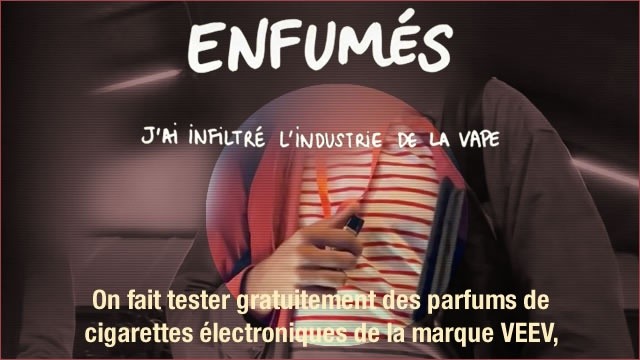
Documentary ‘Enfumés’: Undercover at Philip Morris France
26 January 2026
UPDATE 29-01-2026
For the documentary ‘Enfumés’, journalist Manon de Couët went undercover to work at Philip Morris in Paris. The result: an unfiltered insight into the deception and cunning of the tobacco industry, which prefers to operate in the shadows.
By Bas van Lier
Philip Morris says to the outside world that it always adheres to the applicable laws and regulations, but behind closed doors the tobacco manufacturer talks about “marketing in the shadows” and “circumventing the legal restrictions to try to get a message across”. This is evident from the French documentary ‘Enfumés’, for which the journalist Manon de Couët went undercover at Philip Morris in Paris. As an intern and equipped with a hidden camera, she spoke to several employees who explain how circumventing the rules works.
The picture that emerges from this is not entirely unexpected, but nevertheless disconcerting. In order not to get into the crosshairs of anti-tobacco organizations, illegal marketing operations are undertaken in cities in the province. Promotion teams scour bars and restaurants there, where they offer guests heated tobacco products and e-cigarettes, and immediately collect customer data. Philip Morris (PM) takes the risk of them being caught for granted. A lawsuit can easily take ten years, and any fines are part of the business risk. Meanwhile, MPs are being provided with ready-made amendments from PM to change legislation in favour of the tobacco manufacturer.
In the documentary, the recordings within the walls of PM are interspersed with interviews with experts about the harmfulness of alternative nicotine products, which are certainly not as innocent as the tobacco companies would have us believe. Martin Drago of the anti-tobacco organization Contre-Feu also comments on De Couët’s findings.
Marketing in the shadows
“With us it’s: marketing in the shadows and agility,” a PM employee tells De Couët, who managed to get in through an internship as a Brand Content assistant. That marketing in the shadows, says the employee, “means an awful lot of work for me to get something out. And it requires a lot of circumvention strategies.”
So, in an advertisement for the heated tobacco product Iqos, only the heating device is shown, without the tobacco sticks. That device is useless without those sticks, but without those cigarettes on screen, advertising slips through the cracks of the law. De Couët learns en passant that in statements about the Iqos and e-cigarette Veev, the sender Philip Morris remains virtually invisible, to prevent people from feeling cheated by the story about ‘damage control’, while the company is still selling cigarettes in the meantime. “We really want to separate the images of Marlboro and the alternatives to the cigarette.”
Promotion in Bordeaux
Tobacco companies, also in France, are constantly monitored by anti-tobacco organizations. But at PM they know how to deal with that. “Those organizations don’t have a lot of money,” says another employee, “so they don’t travel. They are in Paris and look at the points of sale there. So, what we do, we test in a city that is less eye-catching.” Bordeaux, for example, where PM dares to take more risks. There is more advertising in tobacco shops, geographically localized web advertising too, but above all promotion teams are used that visit bars, restaurants and nightclubs, in the jargon Legal Age Meeting Points (LAMPS).
A colleague of De Couët films in the documentary how that works. When she decides to buy an Iqos device after an encounter with such a promotional team, she turns out to be bombarded with emails and messages in the following days. She even gets a call from someone who suggests coaching her. Coaching to quit smoking? she wants to know. “No, no, absolutely not,” is the answer. “Iqos is not a tool to quit tobacco. It is another way to use nicotine. What we offer is coaching on how to use the device.”
Alternatives are also harmful
The promotion teams are sent out with the marketing story, which has often been debunked, that the tobacco alternatives are 95 percent less harmful than traditional cigarettes. These claims are put in a different light in the documentary by experts such as the French cardiologist Maxime Boidin, working at the University of Manchester, who showed that the use of e-cigarettes is harmful to the heart and blood vessels, possibly resulting in an infarction or chronic conditions in the long run.
And in Lausanne, De Couët speaks with toxicologist Aurélie Berthet, who investigated the emission of heated tobacco and found that the smoke from the Iqos sticks contains the same carcinogens as cigarettes. And it doesn’t matter whether the concentrations of those substances are lower, because they are substances that have no threshold value for the potential to cause cancer.
Data from 88,000 people
Promotion teams also appear to be walking around in Montpellier, Toulouse, Nantes and Lyon, to get people to use e-cigarettes. Consumers can try different flavours for free. If they decide to buy an e-cigarette kit for 16.99 euros, they must first fill in a questionnaire on an iPad. In France alone, contact details of 88,000 people are collected. In cities where the promotion teams are active, sales are 37 percent above the national average. In Bordeaux, the market share reached a record high after two years, for which the team was patted on the shoulder by the director.
Legal proceedings offer postponement
The risk that the tobacco manufacturer will be caught with such illegal promotions is taken for granted, explains a legal assistant. In France, Philip Morris has previously been convicted of illegal advertising for Iqos and again at the beginning of last year. But the employee says: “I’m not going to lie that we are in a very good period now. Because there is a conviction from the Court of Appeal, but we have appealed to the Court of Cassation. And as long as that is ongoing, the conviction is suspended. While we wait, we are not going to stop the business because we have a conviction.”
But this employee acknowledges that the risk is increasing. The previous conviction amounted to a fine of 500,000 euros. “But in the case of recidivism, it is much more. Then you’re talking about millions. And it can go to a product ban, a ban on selling the product.” But legal proceedings can easily take ten years, and a lot of money is made in the meantime.
Lobbying politicians
The documentary is also about political influence. Through a transparency authority (Haute Autorité pour la Transparence de la vie publique) and with a little help from a researcher, De Couët uncovers that 29 lobby organizations in favour of the tobacco and nicotine industry spent 2.25 million euros on lobbying in 2024. Philip Morris alone spent 650,000 euros. For example, on the drafting of an amendment to legislation, which was submitted by MP Charles de Courson of the centrist party LIOT. He sees no problem with this and calls it ‘intolerable’ if parliamentarians would not be allowed to have contact with tobacco manufacturers.
But there appears to be more to it, because a former assistant of De Courson now works at PM. This revolving door between public functions and appointments in the tobacco industry, called pantouflage in French, is also the most normal thing for De Courson. “I don’t see the problem of pantouflage,” he says. “There is none. I have more former employees who have gone to work at PR agencies. Logically, they know the workings of the Assembly, they come to visit parliamentarians to tell them the problems of their companies.”
The regular reader of TabakNee will not really be surprised by this look behind the scenes of the tobacco industry. And yet ‘Enfumés’ is a revealing documentary, because it exposes the deception and cunning of an industry that makes enormous profits at the expense of the lives of its customers. High time for that product ban that the legal assistant fears.
'Enfumés, j'ai infiltré l'industrie de la vape' is written and directed by Manon de Couët and produced by Bonne Pioche Télévision (Martin Boudot) for Slash / France Télévisions. A teaser of ‘Enfumés’ can be found on YouTube. The entire documentary can be viewed in France via France.tv. On YouTube , Manon de Couët also provides a further explanation.
MP contacts public prosecutor about ‘Enfumés’
Nicolas Thierry, MP for The Ecologists (EELV) from Gironde, has contacted the public prosecutor’s office following the documentary ‘Enfumés’, reports Franceinfo. Thierry accuses PMI of illegal advertising by the producer of tobacco and electronic smoking products in Bordeaux. “Nicotine products are not allowed to be promoted outside the regular stores. Here we are dealing with a flagrant violation,” he states. Especially since it is a deliberate strategy to use Bordeaux as a test laboratory out of sight of anti-smoking organizations.
tags: tobacco lobby | lawsuit | vape-hype | IQOS | undercover | PMI





 Stichting Rookpreventie Jeugd is geregistreerd als Algemeen Nut Beogende Instelling (RSIN: 820635315 | KvK: 34333760).