

Dutch Health Ministry wants MPs to comply with FCTC Article 5.3
11 December 2025
UPDATE 05-01-2026
The Ministry of Health, Welfare and Sport has already repeatedly urged the House of Representatives to comply with FCTC Article 5.3 in order to keep out the tobacco industry’s lobby. A new letter was sent to the new House after the recent elections, the responsible official said in an interview.
By the web editors
The Ministry of Health, Welfare and Sport (VWS) in the Netherlands recently sent a letter to the new Dutch Parliament to remind the MPs of the obligations arising from the anti-lobby article 5.3 in the WHO Framework Convention on Tobacco Control (FCTC). This is what Ingrid Zweep, responsible for the implementation of Article 5.3 at the Ministry, says in a publication by the World Health Organization (WHO). In Voices of local advocates: Defending article 5.3 in action of last October, Zweep explains how the Health Ministry has already tried several times to hold the House of Representatives to the article in the WHO treaty, which is intended to prevent the tobacco industry from influencing tobacco policy.
Zweep, senior legal advisor in the tobacco team of the Ministry, also explains in the interview that the tobacco industry and the trade association of tobacco retailers have tried to challenge the implementation of Article 5.3 through the Dutch Ombudsman. But the Ombudsman concluded in 2020 that they had no case. The government then stuck to its interpretation of the treaty article, that contact with the tobacco industry must be limited to what is strictly necessary for the implementation of established policy.
Protocol for dealing with the tobacco industry
In 2015, under pressure from a lawsuit filed by Youth Smoking Prevention (RPJ) about compliance with the anti-lobby article in the FCTC treaty, then State Secretary Martin van Rijn (VWS, PvdA) decided to send a letter to all ministries, provinces and municipalities with a clarification on how to deal with the tobacco industry. A few months later, a further protocol followed addressed to all governments.
Since then, it has regularly been discussed that Article 5.3 also applies to the House of Representatives, which after all has the last word in the legislative process. But time and again, the House did not want to impose any restrictions on itself in this regard.
Speaker: ‘Article 5.3 is not for MPs’
In 2019 the Speaker of the House of Representatives reiterated the position that Van Rijn’s instructions do not apply to Parliament. She stated, “that it is important for MPs to be able to broadly orient themselves on all facts and interests relating to a social issue before they determine their position.” And that “in order to avoid the appearance of a conflict of interest, it is wise for MPs to be transparent about the contacts they have.” In 2021, the issue was raised again by two MPs, without a different result.
In the interview with the WHO, Ingrid Zweep now says that letters were sent from the Ministry of Health, Welfare and Sport to parliament “urging compliance with Article 5.3.” Nevertheless, parliament continued to insist that communication with the tobacco industry should remain possible. Zweep: “Consequently, industry influence on policymaking persists, with implications for the effective implementation of Article 5.3.”
Policy making must be shielded
Zweep argues that tobacco policy development in the Netherlands has been secured, because the tobacco industry only has the opportunity to respond to technical aspects of legislative proposals for the first time in an internet consultation. “This contributes to ensuring that policy is not influenced by the interests of the tobacco industry,” says Zweep. “The situation differs when legislation subsequently passes through Parliament. The House of Representatives, which represents the Dutch population, is an independent legislative body with its own responsibilities.”
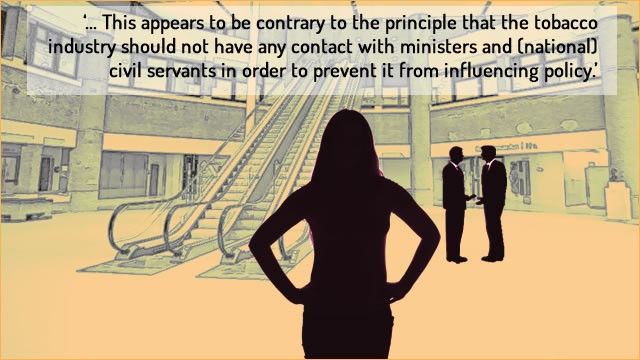
The new letter sent to the House asks to discuss the applicability of Article 5.3 to MPs again, says Zweep. “Previous negative decisions by the Presidium on this matter (2017/2019) imply that tobacco lobbyists could still exert influence on tobacco control policy and related legislation through Parliament. This appears to conflict with the principle that the tobacco industry should have no contact with ministers and (national) civil servants to prevent policy influence. The commercial interests of the tobacco industry are explicitly incompatible with public health. If the House of Representatives also agrees to comply with Article 5.3, the entire tobacco policy development process will be protected.”
Recently, Denmark, Norway and Iceland published a joint policy paper on the application of Article 5.3 which explicitly states that this also applies to parliamentarians.
A reminder every five years
The lawsuit that RPJ conducted against the state in 2014/15 is briefly mentioned at the very end of the interview, without indicating that this was the prelude to the current government policy for dealing with the tobacco industry. According to Zweep, all relevant ministries, provinces and more than 400 municipalities are reminded of this policy by letter every five years. “In addition, similar reminder letters are periodically sent to Members of Parliament to ensure their continued awareness of Article 5.3,” says Zweep.
Letter to Parliament forthcoming
Further information from the Ministry of Health, Welfare and Sport (VWS) indicates that the letter to the House of Representatives mentioned in the above article has not yet been sent, but will be shortly.
tags: Youth Smoking Prevention | FCTC | VWS | tobacco lobby







 Stichting Rookpreventie Jeugd is geregistreerd als Algemeen Nut Beogende Instelling (RSIN: 820635315 | KvK: 34333760).